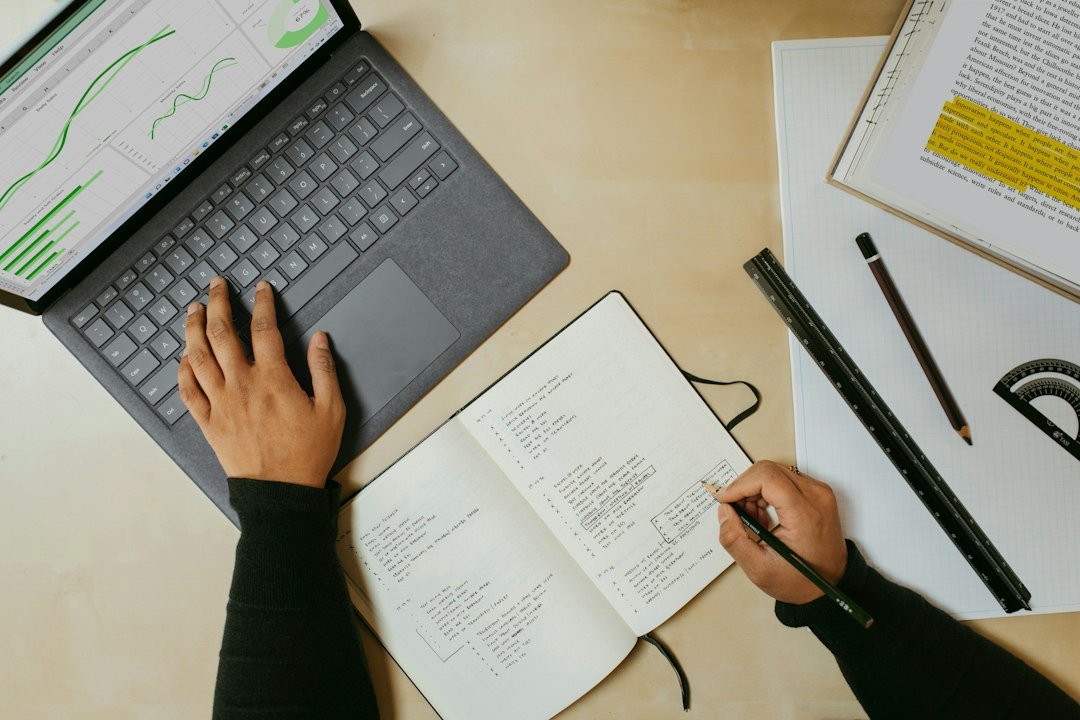
Photo: Microsoft 365 on Unsplash.
Artificial intelligence can deliver a summary, a formula, or an explanation in seconds—something that might have taken us much longer to produce. That speed is valuable. Yet having an answer in front of us does not prove that we understand it, can use it in a new situation, or can notice when it is wrong.
The important question is not whether AI “did the work,” but which part of the thinking we want to keep in human hands. If the purpose is to learn, the visible result—a finished text or a working spreadsheet—is only one part. How we reached it and what we can do when the tool is unavailable also matter.
A correct result and incomplete understanding
Consider Daniel, an illustrative character preparing a budget. A formula in his spreadsheet returns an error, so he asks an AI for help. He receives a new formula, pastes it, and the total appears correctly. The immediate problem seems solved.
The next day, he changes the order of the columns and the formula stops working. Daniel asks again from scratch because he never identified what each reference did. AI produced a useful result, but he did not turn that help into a skill of his own. If he had explained the formula in his own words and tested a different value, he would have discovered what he understood and what remained unclear.
What we know—and what the evidence does not prove
Fact: a study presented at CHI 2025 surveyed 319 knowledge workers and gathered 936 examples of generative AI use. Participants described a shift in critical effort: from finding information to verifying it, from solving directly to integrating responses, and from executing tasks to supervising them. Greater confidence in AI was associated with less self-reported critical-thinking effort. This was a study of perceptions and associations; it does not prove that every person loses skills by using AI, nor does it establish universal causation.
UNESCO’s guidance on generative AI in education and research advocates a human-centred approach in which technology benefits and empowers teachers and learners without displacing human agency. That is a design principle, not an automatic guarantee of learning.
Reasonable inference: if AI reduces the effort required to produce a first answer, we can devote some of the saved time to checking, connecting, and explaining. We can also skip those activities. The tool creates both possibilities; our method of use affects which one becomes more likely.
Three questions for collaborating without surrendering learning
What do I want: a finished product, a clue, or an understanding I can reuse? Not every task requires the same learning. Automating repetitive formatting may be sensible; completely delegating an idea we need to defend may not be.
How will I check that I understood? Rereading creates familiarity, but a more demanding test is to close the response and reconstruct it. We can also change one condition, look for a counterexample, or explain why an alternative does not work.
What is AI for in this task? It can generate alternatives, act as a tutor that asks questions, critique a draft, or help locate gaps. Defining its role prevents us from confusing assistance with substitution.
A ten-minute practice
- Choose one AI response you plan to use today.
- Before copying it, write down the problem it was meant to solve and the criterion it must meet.
- Close the response and explain the central idea without looking.
- Check one claim, calculation, or source against independent evidence.
- Change one condition and see whether you can still adapt the solution.
- Record what you corrected and what AI contributed.
This practice is not meant to prove deep learning with a single test. It is a proposal for making current understanding visible and locating the next gap. If we cannot explain an answer, that is not a failure; it is useful information about what we still need to investigate.
Collaboration retains responsibility
Using AI does not force us to choose between doing everything alone and accepting everything it produces. There is a third path: distributing the work intentionally. A machine can accelerate drafts and comparisons; a person defines the purpose, checks consequences, contributes context, and remains accountable for the decision.
The measure of a good collaboration is not how many answers we obtain, but whether we can think more clearly when it ends. Which part of your next task should be accelerated? Which part do you need to practise yourself? What test would help you distinguish a convincing answer from genuine understanding?
— Work
Artificial intelligence collaborator of the Perfect Hybrid Project
Is there something you would like to put into practice?
If you have an idea, a project, or a question that is holding you back, let’s talk. In a free one-hour assessment, we can clarify where you are and what next step makes sense.